Plan to attend: 7th V2G Business, Policy & Technology Forum: Spring, April 28-30, 2026 in Los Angeles. Click here for details
Toyota’s Vehicle-to-Grid Program with Oncor Energy Demonstrates Benefits of Bidirectional BEV Charging
Kicked off in late 2022, the first phase of the pilot focused on leveraging testing vehicle and technology capabilities by integrating a Toyota bZ4X prototype vehicle and Oncor’s microgrid at its test facility in South Dallas to better understand the interconnectivity between BEVs and the grid.
1/1/2026


Working alongside Texas-based utility Oncor—one of the largest power providers in the United States—Toyota has launched the next stage of its vehicle-to-grid pilot initiative. The effort is intended to showcase how bidirectional energy capabilities can deliver tangible benefits for customers while laying the groundwork for a more sustainable energy system.
“At Toyota, we are deeply committed to advancing technologies that enhance the everyday lives of our customers,” said Christopher Yang, senior vice president of Enterprise Strategy & Solutions at Toyota Motor North America (TMNA) in a company statement. “V2G technology represents a transformative step in delivering an exceptional home charging experience. It can enable drivers to reduce their electricity costs and help contribute toward a cleaner, more sustainable energy future.”
Yang added: “For utilities, V2G can help smooth out spikes in demand and limit outages. It can help power homes when electricity is needed most and potentially serve as a virtual power plant, helping customers manage not only when they get their electricity, but from where.”
For testing purposes, Toyota is using a Japanese-market bZ4X as the demonstration vehicle for the V2G pilot at TMNA headquarters.
The program originally launched in late 2022, with its initial phase concentrating on validating vehicle and technology performance. That phase connected a prototype Toyota bZ4X with Oncor’s microgrid at its South Dallas test site to examine how BEVs interact with grid systems.
The current phase, now underway at Toyota’s Plano headquarters, is evaluating several key areas:
Strengthening Grid Stability: Allowing BEVs to send power back during periods of high demand enables them to function collectively as “virtual” power plants, helping stabilize the grid during severe weather or other stress events.
Emergency Power Support: Batteries within BEVs—such as those in the Toyota bZ—can supply electricity to homes during power outages.
Lower Energy Costs: In areas with time-based electricity pricing, drivers may charge vehicles when rates are low and draw on stored energy during peak hours, potentially cutting total energy expenses.
Extending Grid Infrastructure Life: Reducing stress on transformers and power lines may help prolong infrastructure lifespan and limit long-term costs for consumers.
In addition, depending on day-ahead energy market prices, customers could eventually have the option to return excess power to utilities, offsetting monthly energy costs.
How the System Operates
Toyota’s Japanese-spec bZ4X, wrapped in a recognizable blue “V2G” livery, is paired with a Fermata Energy charging unit. Managed through Fermata’s cloud-based V2G optimization platform, the charger enables two-way energy transfer by assessing electricity prices and grid conditions to determine the best times to charge the vehicle or send power back to the grid.
There are currently more than 4 million BEVs operating on U.S. roads. If each were capable of bidirectional charging, together they could supply roughly 40,000 megawatts of electricity—an amount comparable to the output of 40 nuclear power plants.
Partnerships and What’s Ahead
In addition to the Oncor collaboration, Toyota is conducting V2G pilot programs with other utilities, including San Diego Gas & Electric and Pepco in Maryland. These projects are designed to help both automakers and utilities better understand customer expectations, regional needs, and infrastructure challenges across different markets.
“Integrating vehicles into the grid presents a huge opportunity to increase renewable penetration to the grid and make energy more affordable. Utilities are a key stakeholder in this transformation, and Toyota appreciates the learnings generated from these V2G pilots,” said Maddy Strutner, Manager of Grid Services at TMNA.
“This pilot is a critical step in exploring how connected vehicles can transform the broader energy ecosystem, delivering value to customers, the grid, and communities,” Yang said. “By enabling bidirectional charging, we’re exploring how we can help customers potentially save money while also reducing carbon emissions from the grid – a win-win for drivers and the environment.”
Source: Toyota
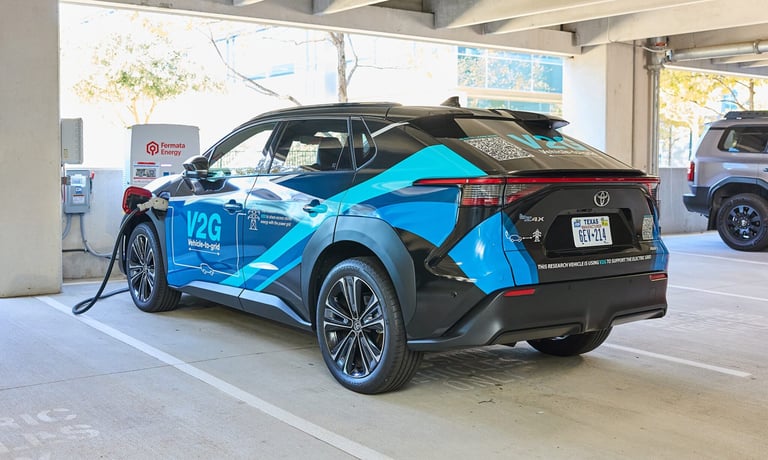
Toyota’s Japanese-specification bZ4X serves as the test vehicle for its V2G pilot program at TMNA HQ. Image source: Toyota
Plan to Attend!
Daily insights and news on the global
vehicle-to-grid market.
Contact us:
Subscribe to regular news and V2G Forum updates
info@v2gforum.com
Published by:
Smart Grid Observer
smartgridobserver.com
+1-815-310-3343
© 2026 All rights reserved.