Plan to attend: 8th V2G Business, Policy & Technology Forum: Fall, October 27-29, 2026 in Detroit. Click here for details
New Jersey Announces Eco-Hub Program to Demonstrate Grid Benefits of Bi-Directional Charging
“New Jersey is leading the way in clean transit, transforming school buses into energy hubs that power our schools and will add over 2,100 MWh of storage to the grid,” said NJBPU President Christine Guhl-Sadovy. “The Eco-Hub pilot provides a real-world roadmap to scale this smart infrastructure, cutting pollution while protecting our students and our energy future.”
1/26/2026
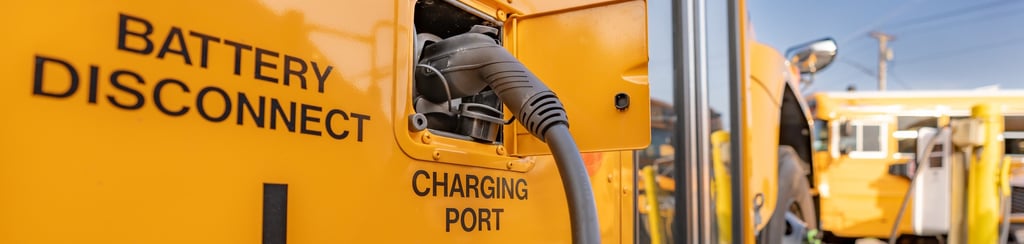

The New Jersey Department of Environmental Protection and Board of Public Utilities earlier this month announced the launch of a groundbreaking Eco-Hub pilot program to demonstrate the potential benefits of electric vehicle bi-directional charging to help power the electric grid and contribute to lower energy rates.
During the first phase of the program, two schools – Christina Seix Academy in Trenton and Hanover Park Regional High School District in Hanover Park – will be equipped with bi-directional charging stations and electric school buses.
They will also be supplied with power from onsite solar and batteries that will utilize a microgrid controller to manage the storage and transfer of excess energy captured through the solar panels. This will decrease their reliance on the electric grid and increase the use of renewable energy.
The pilot is funded through the DEP’s Electric School Bus program and an additional $4 million from the BPU to fund the technology needed for the bi-directional and Vehicle to Grid infrastructure.
“New Jersey is leading the way in clean transit, transforming school buses into energy hubs that power our schools and will add over 2,100 MWh of storage to the grid,” said NJBPU President Christine Guhl-Sadovy. “The Eco-Hub pilot provides a real-world roadmap to scale this smart infrastructure, cutting pollution while protecting our students and our energy future.”
“Schools are increasingly turning to electric school buses to protect students from harmful diesel emissions,” said Environmental Protection Commissioner Shawn M. LaTourette. “The Eco-Hub project provides an opportunity to build on this trend, better protecting children and our air quality.”
While providing vital transportation services, school buses powered by fossil fuels adversely affect the health of students, drivers, and residents of communities in which they operate. Exposure to these pollutants increases the risk of heart and lung illnesses and premature death for thousands of New Jersey residents.
This program supports the transition to electric school buses in mitigating these impacts and meeting the state’s emission goals. Utilizing a fully renewable microgrid configuration to ensure the buses are truly zero-emission, this project will lead to significant greenhouse gas emissions reductions, criteria and hazardous air pollutant reductions, and improved health for New Jersey communities.
Supported by New Jersey’s Electric School Bus Grant Program, a partnership of the DEP and BPU, the state will soon have more than 240 electric school buses in operation. But there are more than 21,000 school buses and nearly 500,000 other medium- and heavy-duty vehicles in New Jersey, demonstrating a great source of untapped potential for bi-directional technology. The U.S. Public Interest Research Group, for example, estimates that converting all New Jersey school buses to bi-directional capable electric school buses would add over 2,179 MWh of storage to the grid.
Next Steps
Eight additional schools are undergoing initial feasibility screenings to provide high-level estimates of their electric grid capacity, space availability, timelines, and cost assumptions. These assessments will lead to the design and implementation of at least two additional projects.
Each eco-hub project will provide a variety of benefits, including:
Transitioning to cleaner school buses enhances student health by reducing exposure to harmful diesel emissions
Providing insights from the bi-directional charging to guide the development of a future vehicle-to-grid (V2G) framework for the state
Drawing electricity from on-site solar, battery storage, and electric buses to help schools cut energy costs and alleviate grid pressure during peak demand
Reducing grid pressure contributes to grid stability and minimizes pricing spikes; and
Ensuring continued power during outages, bolstering community resilience.
The program will support schools in deploying electric school buses, bi-directional capable charging stations, solar arrays, battery storage systems, and microgrid controllers to optimize electricity use and distribution.
Through data collection and analysis, the DEP, BPU and the state’s electric utilities will gain a deeper understanding of the financial and operational benefits of bi-directional charging and the beneficial role of electric vehicles in the energy ecosystem.
Source and : New Jersey Department of Environmental Protection
Plan to Attend!
Daily insights and news on the global
vehicle-to-grid market.
Contact us:
Subscribe to regular news and V2G Forum updates
info@v2gforum.com
Published by:
Smart Grid Observer
smartgridobserver.com
+1-815-310-3343
© 2026 All rights reserved.